Fly Agaric
Amanita muscaria
The red-capped icon of the high-country forest.
At a Glance
Scientific Name
Amanita muscaria
Grows With
Pine, fir, spruce and aspen
Season
Late July to September
Status
Poisonous
About This Mushroom
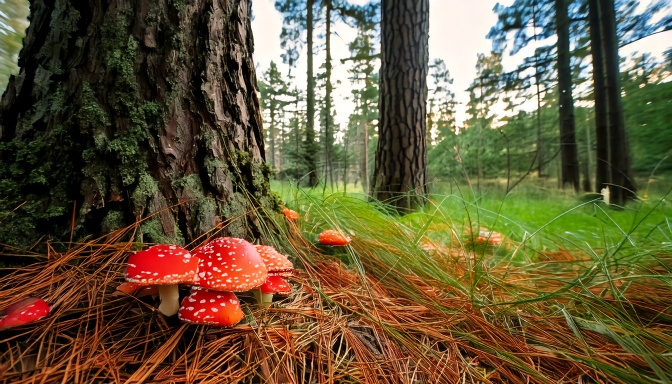
The fly agaric is the mushroom most people picture when they think of a mushroom: a bright red cap dotted with white warts. In southern Arizona it grows in the high conifer forests of the sky islands, where it forms a partnership with the roots of pine, fir, spruce and aspen.
In Arizona the cap color varies. Many caps are a deep red, while others fade to orange or even yellow as they age or after heavy rain washes the color and the warts away. That variability is one reason identification has to rely on several features at once.
Fly agaric contains ibotenic acid and muscimol, compounds that affect the nervous system. It is poisonous and can cause vomiting, confusion and delirium.
How to Recognize It
Check every feature, not just one.
Cap
Red to orange-red, sometimes fading to orange or yellow, 3 to 8 inches across, with white to cream warts that can wash off in rain.
Gills
White and free from the stem, not attached to it.
Stem
White, with a hanging skirt-like ring near the top.
Base
A swollen bulb ringed with rows of white veil remnants. Dig the base out gently to see it.
Spore Print
White.
Where to Find It in Southern Arizona
Look in the highest forests after several soaking monsoon storms: near the summit of Mt. Lemmon, around the upper campgrounds on Mt. Graham, and in the fir forest around Rustler Park in the Chiricahuas. It often appears in scattered groups under conifers along trails and road edges.
Lookalikes
Know what it can be confused with.
Caesar’s Mushroom Relatives
Several orange-red amanitas in the Caesar’s group grow in the Southwest. They usually lack white warts and have yellow gills, a yellow stem and a white sac-like cup at the base.
Other Amanitas
The amanita group includes some of the deadliest mushrooms known. Treat every amanita as dangerous.
Red Russulas
Red-capped russulas have no warts, no ring and no bulb, and their stems snap cleanly like chalk.
Safety
Fly agaric is poisonous. If anyone, including a pet, eats one, call Poison Control at 1-800-222-1222.
Never eat a wild mushroom unless an expert has identified it in person. Photos, apps and field guides are not enough.